In this beginner Japanese grammar lesson, you will learn how to use the particle の to connect two nouns.
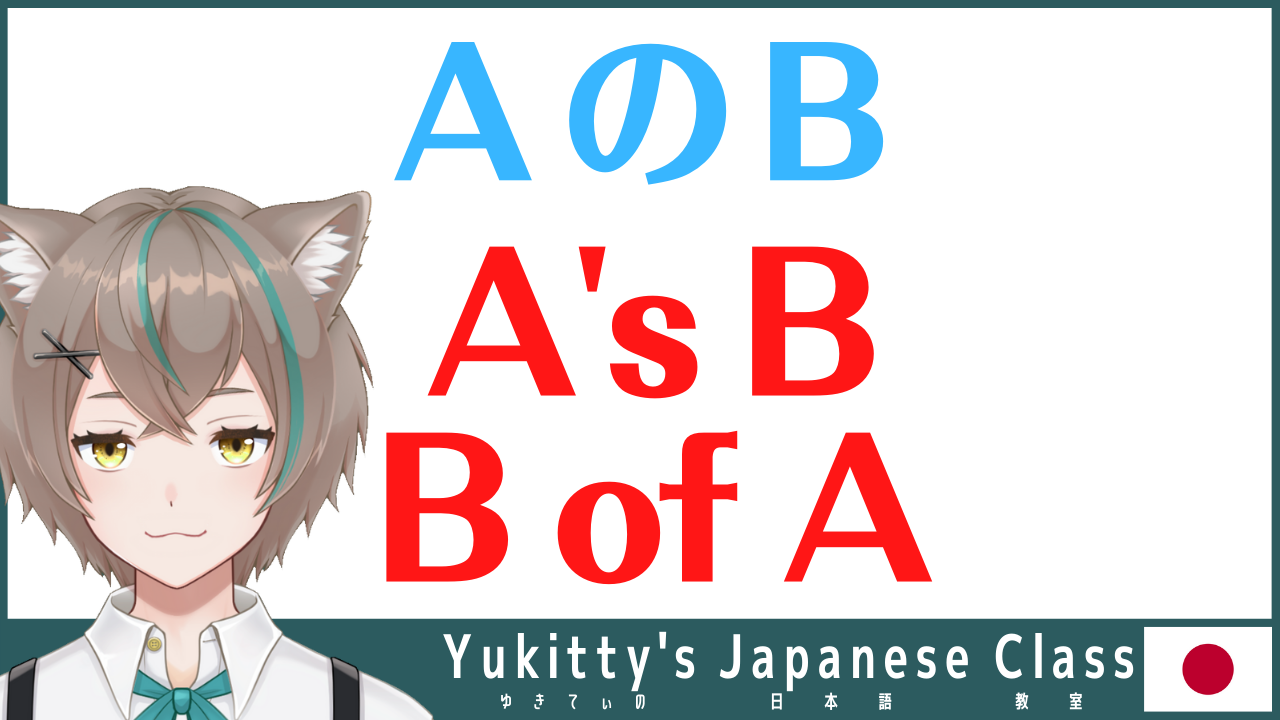
A の B
The particle の is placed between two nouns. In the pattern A の B, the first noun A gives information about the second noun B. It is often translated as “B of A,” “A’s B,” or simply “A B” in English.
The word before の modifies or explains the word after の.
The particle の can express possession, relationship, category, origin, manufacturer, type, and more. Let’s look at the main patterns.
Examples
1. Possession: A’s B
私のスマホ
my smartphone
スマホ / スマートフォン [noun] smartphone
2. Group or Organization: B of A / A’s B
会社のスマホ
a company smartphone / the company’s smartphone
会社 [noun] company, corporation
3. Country or Place: A B / B from A
アメリカのスマホ
an American smartphone / a smartphone from America
アメリカ [noun] America, the United States
In Japanese, country names often work like adjectives when they are followed by の.
4. Manufacturer or Brand: A B / B made by A
アップルのスマホ
an Apple smartphone / a smartphone made by Apple
5. Type or Feature: A-type B
旧型のスマホ
an old-model smartphone
旧型 [noun] old model, old type, older style
6. Apposition: A, who is B / B called A
妹のねずこ
Nezuko, my younger sister / my younger sister Nezuko
妹 [noun] younger sister
If you switch A and B, the meaning changes.
ねずこの妹
Nezuko’s younger sister
A の B の C の …
You can use の more than once in a noun phrase. However, if you use too many の phrases, the sentence can become difficult to read.
私の妹のねずこのスマホはアップルの旧型です。
My younger sister Nezuko’s smartphone is an old Apple model.
東京の秋葉原のメイドカフェの看板のキャラクター
the character on the signboard of a maid cafe in Akihabara, Tokyo
東京 [noun] Tokyo 秋葉原 [noun] Akihabara メイドカフェ [noun] maid cafe 看板 [noun] signboard キャラクター [noun] character
In Japanese, の phrases usually move from broader information to more specific information.
The word before の modifies the word after の. This is the most important rule for understanding A の B.
Practice
Translate the following phrases into Japanese using の.
President Marukawa
社長 [noun] company president, president
President Marukawa
社長のまるかわ
Mario, a video game character from Nintendo, a Japanese company
Hints
日本 [noun] Japan 任天堂 [noun] Nintendo ゲーム [noun] video game キャラクター [noun] character
Mario, a video game character from Nintendo, a Japanese company
日本の任天堂のゲームのキャラクターのマリオ
この, その, あの, and どの
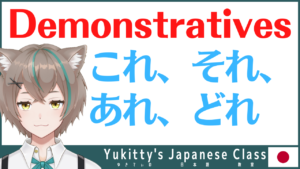
You have already learned about これ, それ, あれ, and どれ in other lessons. In this section, you will learn the related words この, その, あの, and どの.
These words come before nouns, like “this,” “that,” and “which” in English.
これ, それ, あれ
A is B. / A は B です。https://youtu.be/Fh9J3vofJ4E Ever heard an anime character introduce themselves with a quick “○○です” and wondered how that tiny sentence actually works? Tha…
どれ
Is A B? / A は B ですか?How to Say “Is A B?” in Japanese In this beginner Japanese grammar lesson, you will learn how to make simple yes/no questions in Japanese using the pattern A…
Japanese
English
Meaning
Related Word
このA
this A
A close to the speaker
これ
そのA
that A / the A
A close to the listener or already mentioned
それ
あのA
that A over there
A far from both the speaker and the listener
あれ
どのA
which A
used when asking which one
どれ
この, その, あの, and どの
この, その, あの, and どの must be followed by a noun. You cannot use them alone.
Use これ, それ, あれ, and どれ alone. Use この, その, あの, and どの before nouns.
These words are very useful. Once you understand them, you can make many practical Japanese sentences.
Examples
このりんごは美味しいです。
This apple is delicious.
りんご [noun] apple 美味しい [I-adjective] delicious
その本はとても面白いです。
That book is very interesting.
本 [noun] book とても [adverb] very 面白い [I-adjective] interesting, funny
あの人は誰ですか?
Who is that person over there?
人 [noun] person 誰 [question word] who
(あなたは)どのアニメが一番好きですか?
Which anime do you like the best? (あなたは is omitted.)
一番 [adverb] the most, the best, No. 1 好きな [Na-adjective] favorite, like
Practice
You will use several grammar patterns you have already learned.
Translate the following sentences into Japanese using この, その, あの, or どの.
How much is this smartphone?
How much is this smartphone?
このスマホはいくらですか?
That banana is not delicious.
That banana is not delicious.
そのバナナは美味しくないです。
That teacher over there is very kind.
That teacher over there is very kind.
あの先生はとても親切です。
Which singer is the cutest?
Which singer is the cutest?
どの歌手が一番可愛いですか?
Summary
The particle の connects nouns. In the pattern A の B, A explains or modifies B.
私のスマホ = my smartphone
会社のスマホ = the company’s smartphone
アメリカのスマホ = an American smartphone / a smartphone from America
アップルのスマホ = an Apple smartphone
旧型のスマホ = an old-model smartphone
Remember: the word before の modifies the word after の.
Also remember that この, その, あの, and どの must be followed by a noun.








Comment