


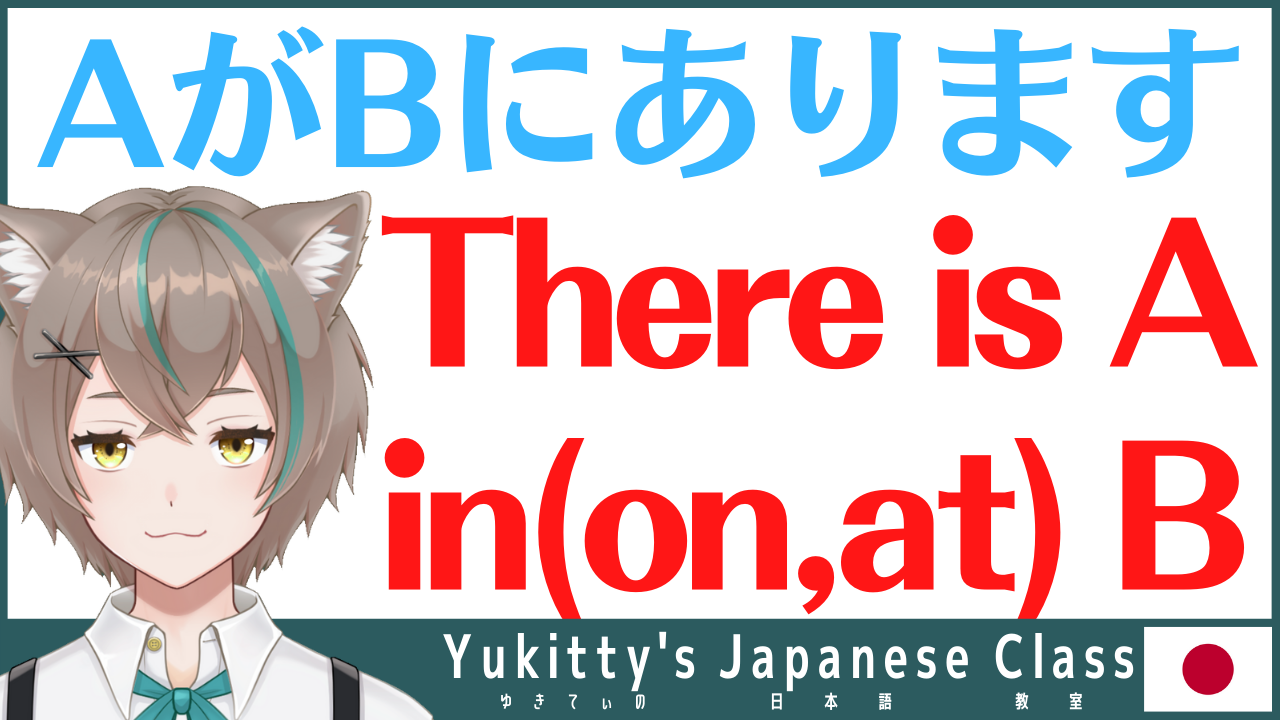
In this beginner Japanese grammar lesson, you will learn how to say that something or someone exists in a place.
A が B にあります。 / A が B にいます。
Use あります for non-living things.
Use います for living things, such as people and animals.
The basic meaning is:
The particles が and に are important.
A が marks what exists, and B に marks where it exists.
You can also change the word order:
Both sentences have almost the same basic meaning. The second pattern often sounds more natural when the location is the starting point of the sentence.

You can use は instead of が, but the nuance changes. が simply marks what exists, while は makes that thing the topic.
For example, A は B にあります。 means something like “As for A, it is at B.”
If the location is already clear from the context, you can omit it and simply say A があります or A がいます.
To say where something is, Japanese often uses the pattern B の location word に, such as 机の上に “on the desk.”
| Japanese | Hiragana | Relationship with B | Location Meaning | Direction Meaning |
|---|---|---|---|---|
| 上 | うえ | Bの上 | above B, on B | up |
| 下 | した | Bの下 | under B, below B | down |
| 右 | みぎ | Bの右 | to the right of B | right |
| 左 | ひだり | Bの左 | to the left of B | left |
| 前 | まえ | Bの前 | in front of B | front |
| 後ろ | うしろ | Bの後ろ | behind B | back / rear |
| 中 | なか | Bの中 | in B, inside B | inside |
| 近く / そば | ちかく / そば | Bの近く / Bのそば | near B, close to B | – |
| 隣 | となり | Bの隣 | next to B | – |
| 横 | よこ | Bの横 | beside B, to the side of B | – |
| 間 | あいだ | BとCの間 | between B and C | – |
| ここ | ここ | ここ | here | こっち |
| そこ | そこ | そこ | there, near the listener | そっち |
| あそこ | あそこ | あそこ | over there | あっち |
You can combine some direction words.
For example, 右上 means “upper right,” and 左後ろ means “behind and to the left.”
右 or 左 usually comes first, followed by 上, 下, 前, 後ろ, 隣, or 横.
Translate the following sentences into Japanese using location and direction words.
There is a banana on the desk.
There is an escape button on the upper left of the self-destruct button.
Mario is in the pipe under the Piranha Plant.
あります can also be used when talking about time, availability, events, and scheduled things.
When talking about an event happening at a place, Japanese often uses で instead of に.
The negative form of あります is ありません. The negative form of います is いません.
| Japanese | Negative Form | Used For |
|---|---|---|
| あります | ありません | non-living things, events, time, availability (polite) |
| います | いません | people and animals (polite) |
| ある | ない | non-living things, events, time, availability |
| いる | いない | people and animals |
To say “There is A in B” in Japanese, use A が B にあります or A が B にいます.
For beginners, remember these two patterns first: 場所に物があります and 場所に人・動物がいます.






Comment