


Ever notice how an anime character can shout a single word — like 「駆逐してやる!」— and it somehow counts as a whole sentence? Japanese can do that because its grammar is built very differently from English. The good news: once you understand just three building blocks, even those short, punchy lines start to make perfect sense.
 Yukitty
I will explain the detailed grammar step by step later. For now, it is enough if you can get a general feel for how Japanese sentences work.
Japanese sentence structure may look very different from English, but the basic idea is actually quite simple.
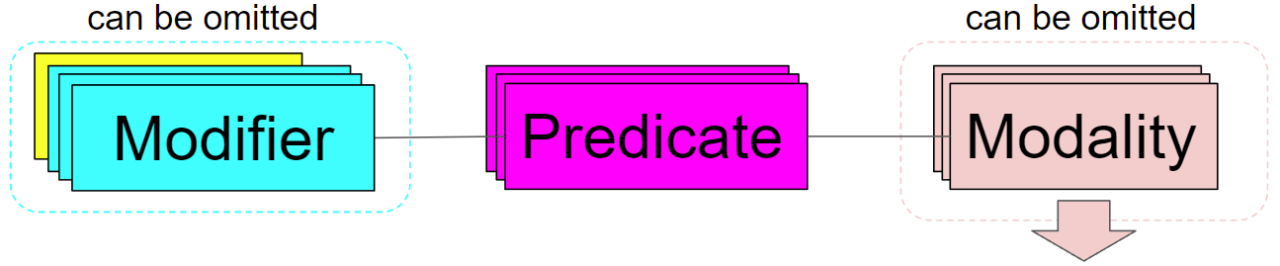
A Japanese sentence can be understood through three main parts: Predicate, Modifier, and Modality.

Before looking at Japanese word order, let’s define these three elements.
A word or phrase that adds information to another word or phrase. In Japanese, modifiers often show information such as who, what, where, when, how, or to whom.
The core part of a sentence. In Japanese, the predicate contains a verb, i-adjective, na-adjective, or noun.
Words or expressions that show the speaker’s attitude, feeling, certainty, politeness, intention, or relationship with the listener.
In other words, the predicate tells us the core meaning of the sentence, modifiers add extra information, and modality shows the speaker’s attitude or nuance.
 Yukitty
For example, the following sentence has three modifiers, one predicate, and one modality expression.

Modifiers are the parts that fill in the details — who did something, what they did it to, where, when, and how. Let’s see how Japanese builds them.
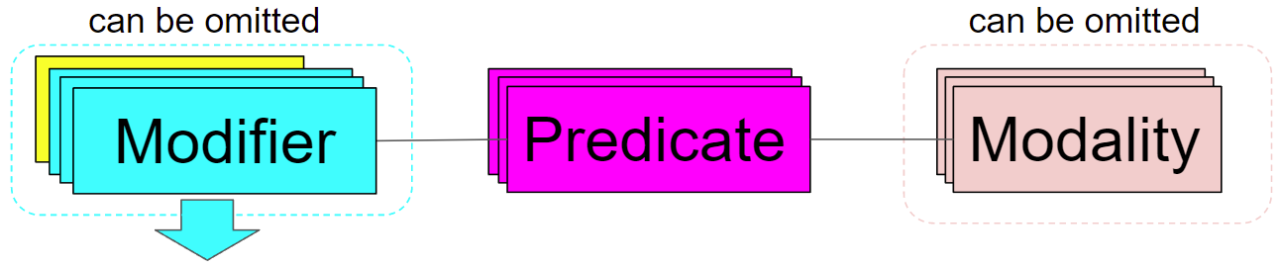
A modifier usually consists of a noun or noun phrase plus a case particle.

Case particles show the role of each noun or noun phrase in the sentence. This is one of the biggest differences between Japanese and English.
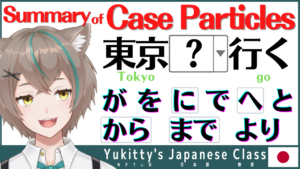
The following are common case particles and their main roles.
| Case Particle | Main Usage / Meaning |
|---|---|
| _____が | subject of a state or action |
| _____を | object of an action |
| _____に | destination, time, target, etc. |
| _____で | location of an action, method, means, etc. |
| _____と | together with, quotation, comparison, etc. |
| _____へ | direction, destination, recipient, etc. |
| _____から | starting point, source, cause, etc. |
| _____より | comparison, starting point, sender, etc. |
| _____まで | limit of time, place, range, etc. |
Because particles show the role of each word, Japanese word order is more flexible than English word order.
Even if you change the order of modifiers, the basic meaning often stays the same because the particles show each word’s role.
YukittyThink of particles like little name tags. In English, word order is the name tag (“the dog bites the man” vs. “the man bites the dog”). In Japanese, the particle does that job instead — so the words can move around more freely!
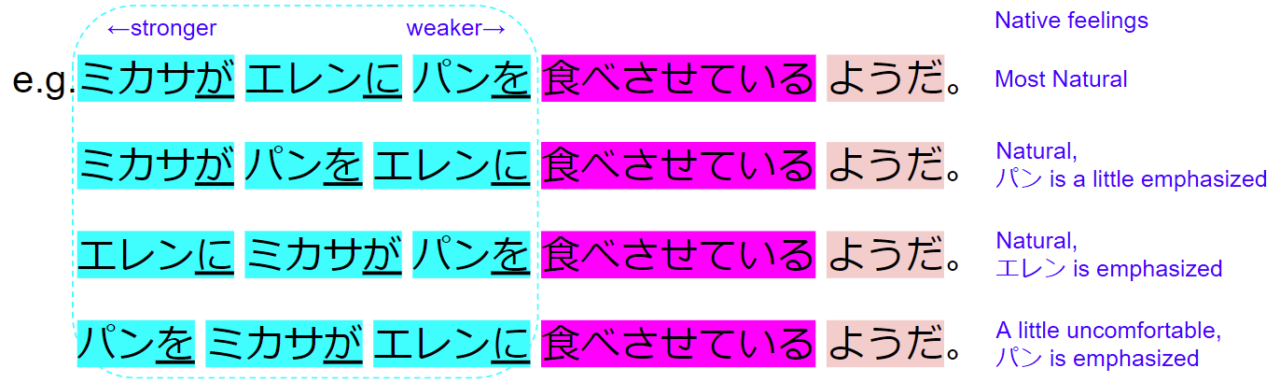
However, word order is not completely random. The word placed earlier in the sentence can sound more emphasized or more important in context.
A natural basic order is often: (1) when, (2) where, (3) who, (4) what, and (5) how.

A topic usually consists of a noun or noun phrase plus an adverbial particle.
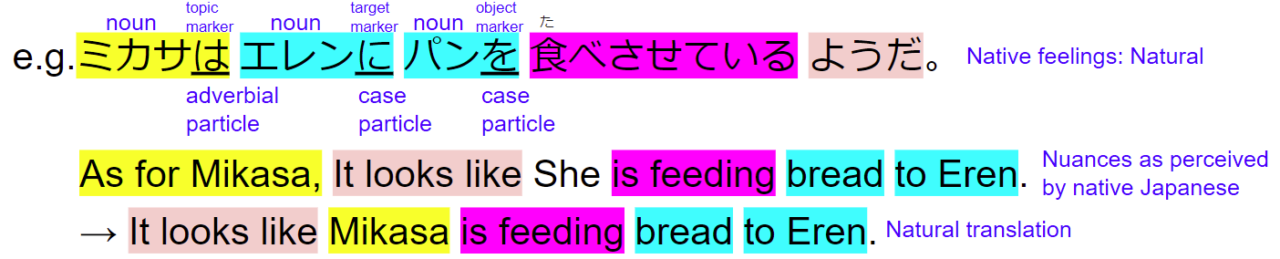
The topic tells the listener what the sentence is mainly about. In Japanese, the topic is extremely important because Japanese often relies on shared context.
The following are common adverbial particles used for topics and related meanings.
| Adverbial Particle | Main Usage / Meaning |
|---|---|
| _____は | topic, contrast, shared context, etc. |
| _____なら | contrast, condition, correlation, etc. |
| etc. | other topic-like or adverbial functions |
The particle は is not simply the same as the English subject. It marks the topic — what the sentence is about.
This is why Japanese sentences can often omit subjects that would be necessary in English.
Yukittyは vs. が trips up almost every learner at first — don’t worry, you’re in good company! We’ll dig into the difference in another article. For now, just remember: は points at the topic.
If modifiers are the details, the predicate is the heart of the sentence. This is the one part you almost never get to leave out — so let’s look at it closely.
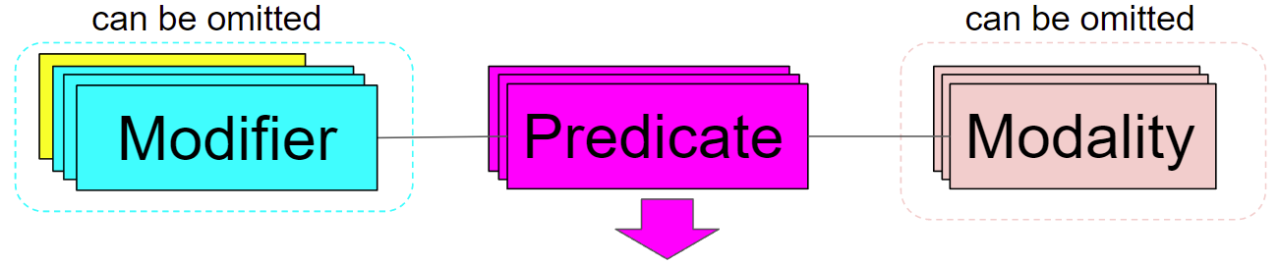
The predicate is the core of a Japanese sentence. It usually comes at the end of the sentence and tells us the main meaning.
Only verbs, i-adjectives, na-adjectives, and nouns can be predicates in Japanese.
This is very important because Japanese sentences are built around the predicate. Modifiers can often be omitted, but the predicate usually cannot be omitted.
海賊王に 俺は なるっ!*
ONE PIECE (C)尾田栄一郎/集英社・フジテレビ・東映アニメーション
In this example, なる is the predicate. It is the main action of the sentence.
この 世界は 残酷だ。* そして、とても 美しい。*
進撃の巨人 ©諫山創・講談社/「進撃の巨人」製作委員会
In Japanese, both adjectives and nouns can work as predicates. This is different from English, where adjectives usually need a “be” verb.
私の 戦闘力は 53万です。*
ドラゴンボール ©バードスタジオ/集英社・東映アニメーション
Here, 53万です works as the predicate. The noun-like expression gives the main information about the topic.
Modality is the “flavor” of a sentence — the part that shows how the speaker feels about what they’re saying. It’s a huge reason Japanese can sound soft, blunt, unsure, or excited with just a tiny ending.
Modality shows the speaker’s attitude, feeling, judgment, certainty, politeness, or intention toward the listener.
In Japanese, auxiliary verbs and sentence-ending particles often express modality.
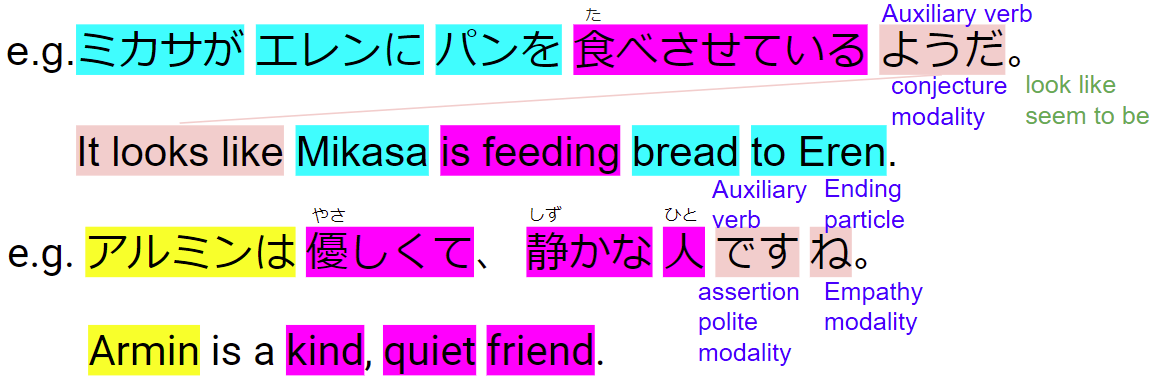
Modality is one reason Japanese can express subtle feelings with short endings such as ね, よ, かな, でしょう, and らしい.
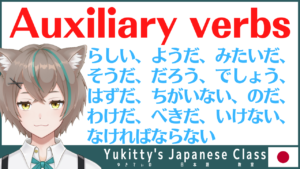
| Auxiliary Verbs | Core Meaning |
|---|---|
| だ、です、ます | assertion, politeness |
| らしい、ようだ、みたいだ、そうだ | conjecture, appearance, hearsay |
| だろう、でしょう | guess, probability, soft conclusion |
| はずだ、ちがいない | confidence, strong expectation |
| のだ、わけだ | explanation, interpretation |
| べきだ、なければならない / いけない | necessity, duty, obligation |
| Sentence-Ending Particles | Core Meaning |
|---|---|
| か、かな、かしら | question, wondering |
| よ、ぞ、ぜ、さ、わ | notification, emphasis, informing the listener |
| ね、よね | seeking agreement, empathy, confirmation |
| な、なあ | admiration, emotion, reflection |
YukittyIf you watch subbed anime, listen for these endings — よ, ね, ぞ, かな. The same sentence with a different ending can sound tough, gentle, or playful. It’s like emotional spice you sprinkle on at the very end! 🌶️
YukittyThere are many more particles and expressions, but I will not cover all of them in this article.
Example: a casual conversation with a close friend
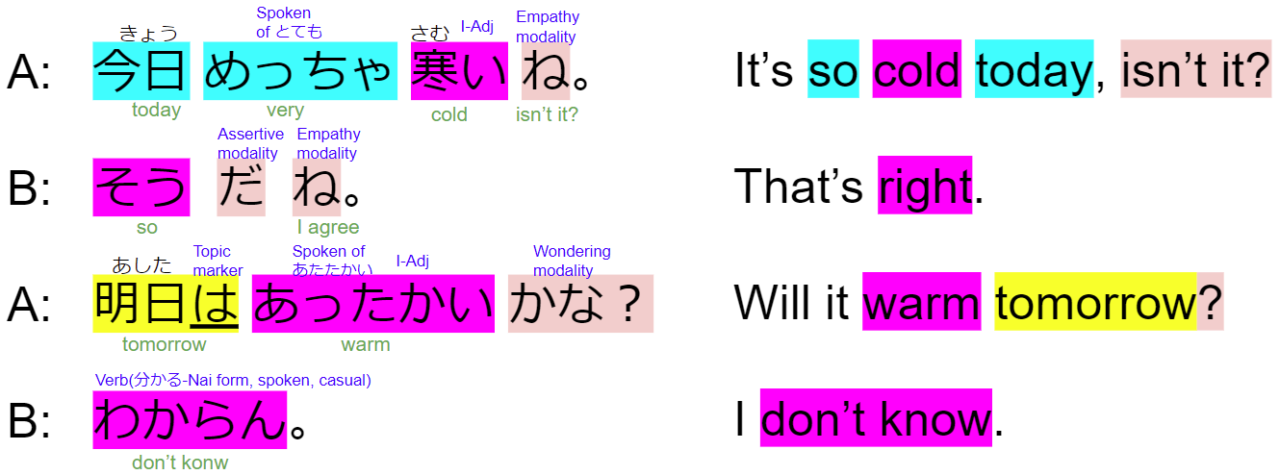
In casual Japanese conversation, sentence endings often carry important emotional nuance. Even when the core sentence is short, the ending can show friendliness, surprise, confidence, uncertainty, or emphasis.
In Japanese, most elements other than the predicate function as predicate modifiers.
These modifiers can often be omitted when they are clear from the context.
The predicate is the core of the sentence. Modifiers add extra information such as who, what, where, when, why, or how.
Because Japanese relies heavily on shared context, native speakers often omit information that both the speaker and listener already understand.
(Modifier 1 + Modifier 2 + … +) Predicate (+ Modality 1 + Modality 2 + …) 。
The subject is especially often omitted in Japanese sentences.
In many situations, if the subject is obvious, it is much more natural to omit it. In fact, repeating the subject too often can sound unnatural to native Japanese speakers.
This is one of the biggest differences between Japanese and English. English usually requires a subject, but Japanese often leaves it unsaid.
気持ち悪い。*
新世紀エヴァンゲリオン ©カラー/Project Eva.
In English, we usually need “it.” In Japanese, however, saying それが can sound unnecessary if the thing being discussed is already obvious.
駆逐してやる!*
進撃の巨人 ©諫山創・講談社/「進撃の巨人」製作委員会
Japanese often sounds short because speakers do not repeat information that is already clear from context.
Japanese word order is more flexible than English word order because case particles show the role of each word in the sentence.
However, the predicate usually comes at the end of the sentence, except in special expressions.
海賊王に 俺は なるっ!*
ONE PIECE (C)尾田栄一郎/集英社・フジテレビ・東映アニメーション
In English, changing word order often changes the meaning or makes the sentence ungrammatical. In Japanese, particles help preserve the grammatical meaning even when the word order changes.
However, a natural basic order is often: (1)when, (2)where, (3)who, (4)what, and (5)how.
e.g. (私は*) 今日 学校で 友達と テニスを した。
*私は is usually omitted in this situation.
Although Japanese word order is flexible, this order sounds natural because it moves from broad contextual information to the core action.
YukittyThese sentence patterns are useful as a reference, but you do not need to memorize all of them at once. Focus first on understanding how the predicate works.
Japanese sentence structure can be divided into the following 10 basic patterns.
Remember: the predicate is the core of the sentence, and case particles show the roles of the other elements.
All dictionary-form Japanese verbs end with the sound “u.”
花が 咲く。
犬が 餌を 食べる。
台風が 日本に 近づく。
人類が 宇宙人と 戦う。
猫が 外国人に 日本語を 教える。
I-adjectives usually end with the sound “i.”
海が美しい。
友人がアニメに詳しい。
Na-adjectives use “な” before a noun, but at the end of a sentence, they usually become “だ” or “です.”
外が静かだ。
電車が時間に正確だ。
A noun can work as a predicate when it is followed by だ or です.
彼女が担当者だ。
Japanese sentence structure may look flexible, but it has a clear logic. Here are the key takeaways to keep in mind:
If you understand predicates, particles, and omission, Japanese sentence order becomes much easier to understand.
Do not worry about memorizing every pattern immediately. Instead, pay attention to the predicate at the end of the sentence and the particles attached to each noun.
YukittyNext time you watch anime, try spotting the predicate at the end of a line and the particles in the middle. Once your ears catch them, Japanese stops feeling like a wall of sound and starts feeling like a puzzle you can actually solve. You’ve got this! 💪








Comment