


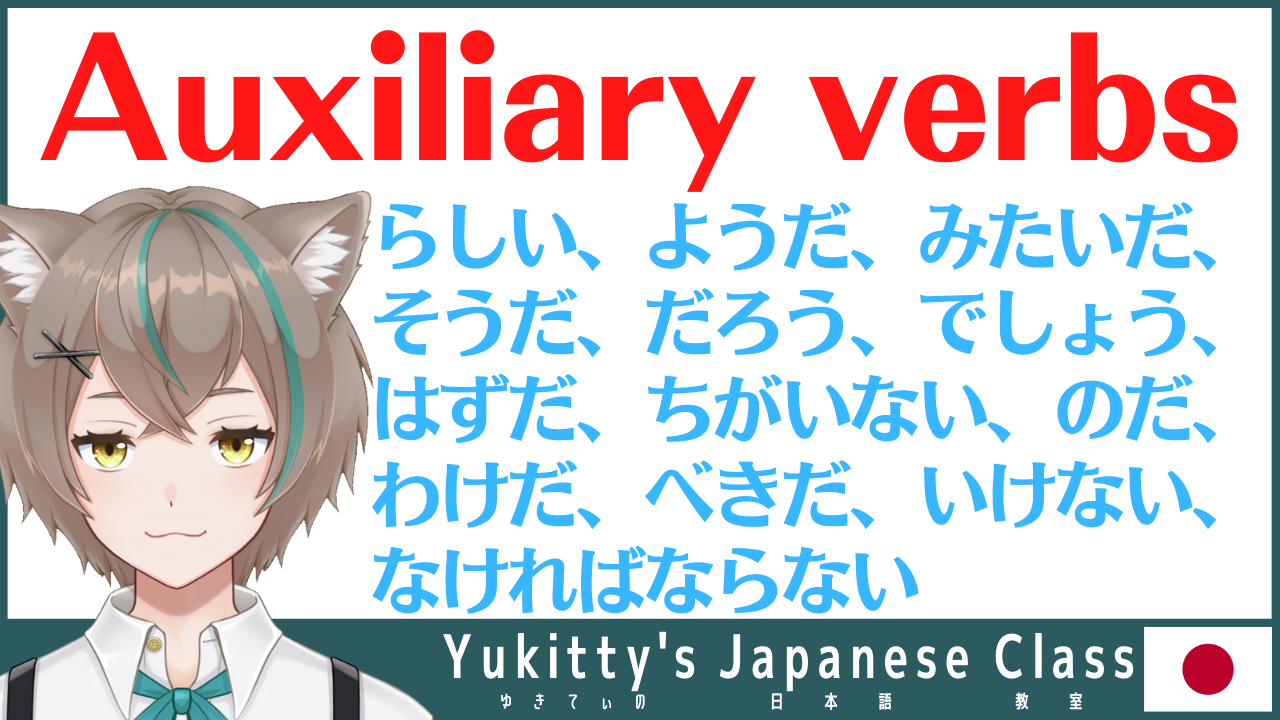
Is he angry? Will it rain? Should you really say that out loud? Japanese folds all these shades of guessing, hearsay, and obligation into small sentence-ending words called auxiliary verbs. They’re how anime characters sound confident, unsure, or bossy — and this guide walks through all six types.
らしい / ようだ / みたいだ / そうだ / だろう / でしょう / はずだ / ちがいない / のだ / わけだ / べきだ / なければならない / いけない
Auxiliary verbs work mainly as part of a predicate. Most of them express the feelings of the speaker. The ending in “da” is similar to Na-adjectives, and auxiliary verbs ending in “i” are similar to the conjugation of I-adjectives.

Auxiliary verbs have 6 types below.
1. Conjecture
2. Hearsay
3. Non-conclusion
4. Confidence
5. Explanation
6. Obligation
These auxiliary verbs indicate that the speaker is estimating based on information obtained from someone or something.
らしい, ようだ, みたいだ or そうだ are usually translated to “seem”, “like” or “look like”.
If you change だ to です, it will be a polite expression. ようです, みたいです, そうです
This auxiliary verb is used to tell the listener what the speaker has heard from others.
If you change だ to です, it will be a polite expression. そうです
These auxiliary verbs are used when expressing the speaker’s opinion.
だろう or でしょう are usually translated to “I think”, “I guess” or “will”.
These auxiliary verbs have no conjugation form as an exception.
These auxiliary verbs are used when expressing the speaker’s strong opinion.
はずだ or ちがいない are usually translated to “should be”, “must be” or “be supposed to”.
If you change だ to です, it will be a polite expression. はずです
These auxiliary verbs are used when expressing the current situation or what was taken for granted.
わけだ is usually translated to “that’s why” or “for that reason”.
If you change だ to です, it will be a polite expression. のです(or んです), わけです
These auxiliary verbs are used when expressing obligations or advice.
べきだ is usually translated to “should”, なければならない is usually translated to “have to” or “must”.
いけない is usually translated to “must not”.
If you change だ to です, it will be a polite expression. べきです
Translate the following sentences into English, paying attention to the auxiliary verbs.
彼女はお金持ちだそうです。
彼女は忙しそうです。
彼女は怒っているようです。
彼女は来るはずです。
廊下を走ってはいけない。
明日は寒いだろう。
Auxiliary verbs attach to the end of a predicate to add the speaker’s attitude. There are six main types:
Watch the endings: those ending in だ behave like Na-adjectives (だ → です to be polite), while those ending in い behave like I-adjectives. Note that そうだ means two different things — “looks like” (conjecture) and “I hear that” (hearsay) — depending on how it attaches.
These little endings are everywhere in anime dialogue — でしょう? はずだ! いけない! Start noticing them and you’ll catch the speaker’s true feelings every time. 🎧







Comment