


Ever heard an anime character introduce themselves with a quick “○○です” and wondered how that tiny sentence actually works? That little pattern — A は B です。 — is the very first building block of Japanese, and you’ll be using it constantly.
Master it once and you can introduce yourself, describe things, state occupations and nationalities, and handle tons of everyday conversation. Let’s break it down.
A は B です。
Unlike English, Japanese does not change the verb depending on the subject. Whether the subject is “I,” “you,” or “they,” the basic pattern remains the same.
You can express simple statements using the pattern A は B です。
You can think of the structure like this:
“は” is pronounced “wa” in this pattern.
Japanese frequently omits topics and subjects when they are obvious from the context.

です is the polite form of だ.
You can also say A は B だ。 in casual speech.
Heads up: writing は but saying “wa” trips up almost every beginner. You’re not alone — your brain gets used to it fast! 😄
Japanese nouns usually do not change between singular and plural.
Context normally tells you whether the meaning is singular or plural.
です can be replaced with だ (casual speech) or である (formal or written style).
When you strongly emphasize the subject, は is sometimes replaced with が.
However, the difference between は and が is more nuanced and will be explained later in this article.
炭治郎といいます。
©吾峠呼世晴/集英社・アニプレックス・ufotable
In Japanese, subjects are frequently omitted when they are obvious from the situation or previous context.
Repeating the subject too often sounds unnatural in many cases.
Japanese self-introductions often omit the subject completely.
Expressions such as ~といいます and ~と申します are very common in natural conversation.
Japanese pronouns are used differently from English pronouns. In natural conversation, they are often omitted when the meaning is already clear from the context.
| Japanese | Pronunciation | English | Note |
|---|---|---|---|
| 私 | watashi | I | often omitted |
| あなた | anata | you | often avoided in conversation; the person’s name is commonly used instead |
| 彼 | kare | he | can also mean “boyfriend” |
| 彼女 | kanojo | she | can also mean “girlfriend” |
| これ | kore | this | something close to the speaker |
| それ | sore | that | something close to the listener |
| あれ | are | that over there | something far from both speaker and listener |
Unlike English, Japanese often relies heavily on context instead of pronouns.


Here are some common occupation words frequently used with the pattern A は B です。
| Japanese | Pronunciation | English |
|---|---|---|
| 学生 | gakusei | student |
| 先生 | sensei | teacher, instructor, professor, doctor |
| 医者 | isha | doctor, physician |
| 弁護士 | bengoshi | lawyer, attorney |
| 警察官 | keisatsukan | police officer |
| 店員 | ten’in | store clerk, salesperson |
| 会社員 | kaishain | office worker, company employee |
| エンジニア | enjinia | engineer |
| 運転手 | untenshu | driver |
| 料理人 | ryoorinin | cook, chef |
| 歌手 | kashu | singer |
Japanese uses many suffixes after names and numbers. These suffixes add politeness, social meaning, or counting information.
| Japanese | Pronunciation | English | Note |
|---|---|---|---|
| ~さん | ~san | Mr. / Ms. | standard polite suffix |
| ~様 | ~sama | Mr. / Ms. | more polite; often used in business settings |
| ~先生 | ~sensei | teacher / professor / doctor | used for teachers, doctors, professors, authors, etc. |
| ~人 | ~jin | nationality | e.g. アメリカ人 = American |
| ~人 | ~nin | people | used when counting people |
| ~歳 | ~sai | years old | used for age |
| ~才 | ~sai | years old | simplified kanji version |
| ~年生 | ~nensei | grader / school year | e.g. 1年生 = first grader |
Translate the following sentences into Japanese using the pattern A は B です。
Ms. Kasumi is a police officer.
I am 25 years old.
The explanations above are enough for basic communication. However, Japanese particles such as は and が contain deeper meanings that are difficult to translate directly into English.
This section explores the deeper grammatical structure behind Japanese sentence patterns and explains why native Japanese expressions often feel very different from English.
In English, the sentence structure is usually analyzed around the subject and verb. Japanese works differently. Japanese focuses more heavily on topics, context, and the relationship between pieces of information.
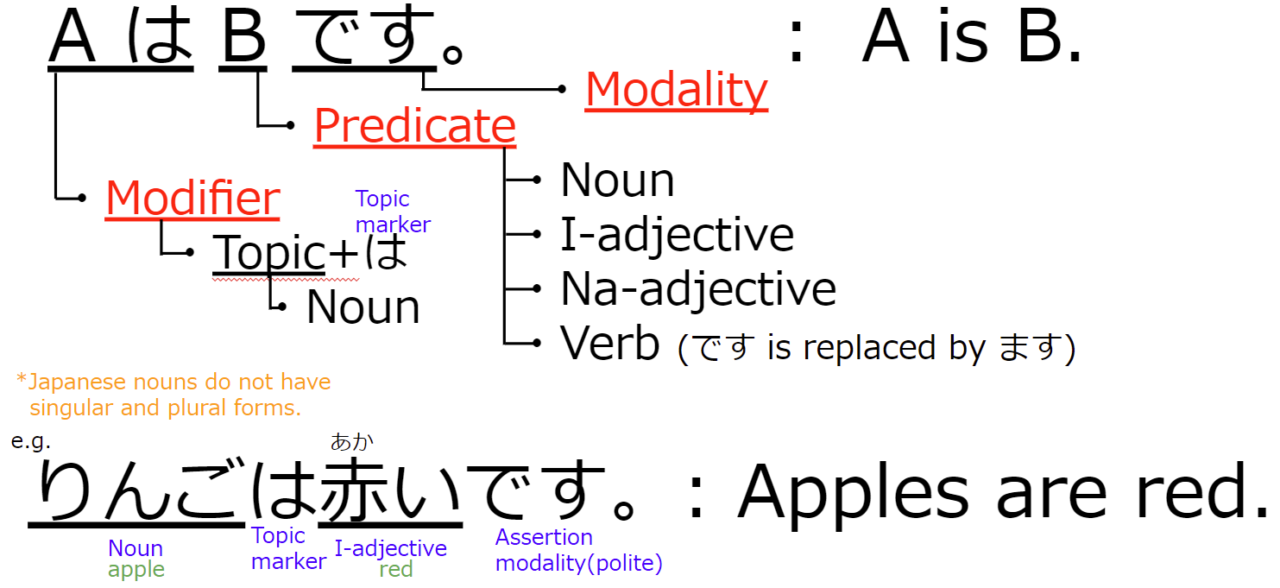
Japanese is often described as a “topic-prominent language,” while English is more “subject-prominent.”
This difference is one of the main reasons Japanese sentences often omit subjects that would normally be required in English.
The particle は is commonly introduced as a topic marker for beginners, but its actual role is much broader and more nuanced.
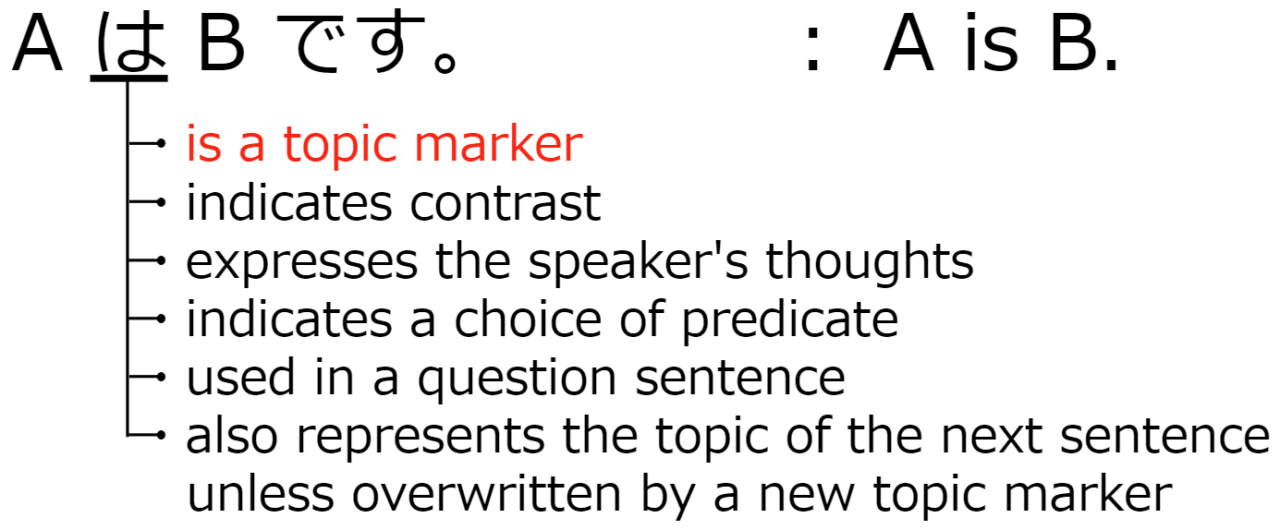
・Functions as a topic marker
In many situations, Japanese speakers avoid repeating information that is already understood by both speakers.
For example, during a self-introduction, the topic “I” is usually obvious from the context.
ゆきてぃです。
The subject “I” is omitted because it is already understood from the situation.
If the subject is explicitly stated when it is already obvious, it often sounds emphasized.
・indicates contrast
・expresses the speaker’s perspective
・indicates a choice of predicate
The particle は often creates nuance rather than direct meaning. Depending on the context, it can imply contrast or highlight the speaker’s viewpoint.
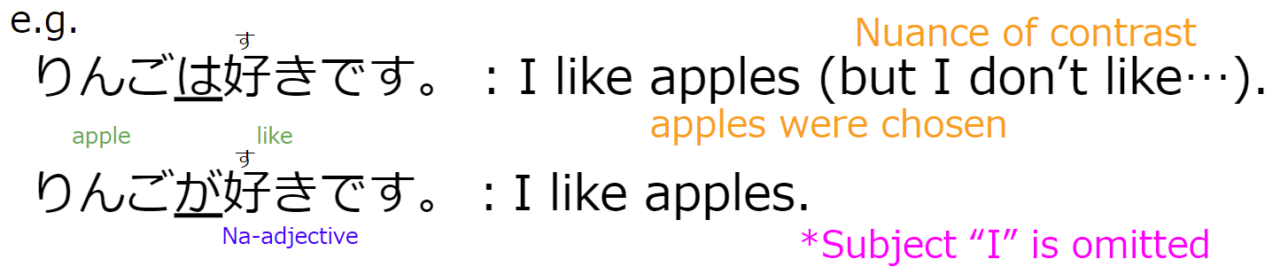
These nuances are difficult to translate directly into English because English usually relies more heavily on word order and intonation.
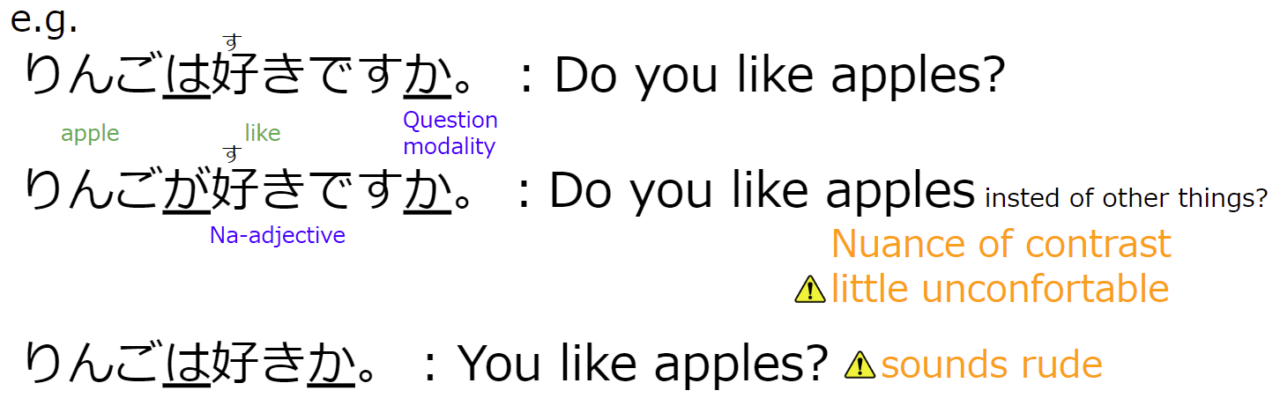
・used in question sentences
The particle は is also frequently used in questions when the speaker introduces or revisits a topic.
・continues the topic into the following sentence unless a new topic is introduced
Once a topic is introduced with は, Japanese often continues discussing the same topic without repeating it.
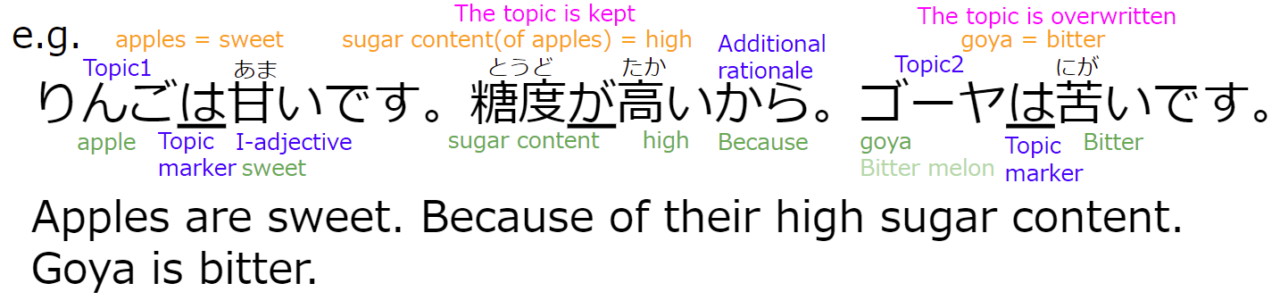
This is one reason Japanese conversations can sound vague to learners. Much of the information is implied rather than spoken explicitly.
Don’t stress about memorizing all six roles of は right now! Even advanced learners are still feeling these out. Just soak in the examples and it’ll click over time. 😄
Both です and だ express judgment or assertion, but they differ in politeness and tone.
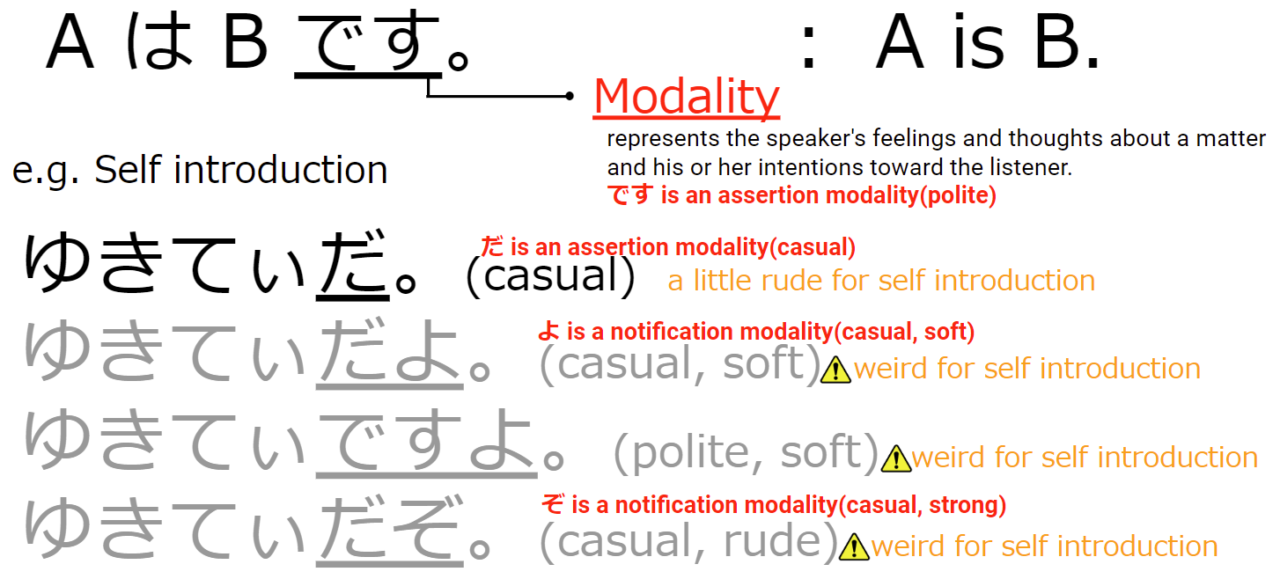
です is polite and commonly used in everyday conversation.
だ sounds more casual and direct.
The form である is often used in formal writing, explanations, articles, and narration.
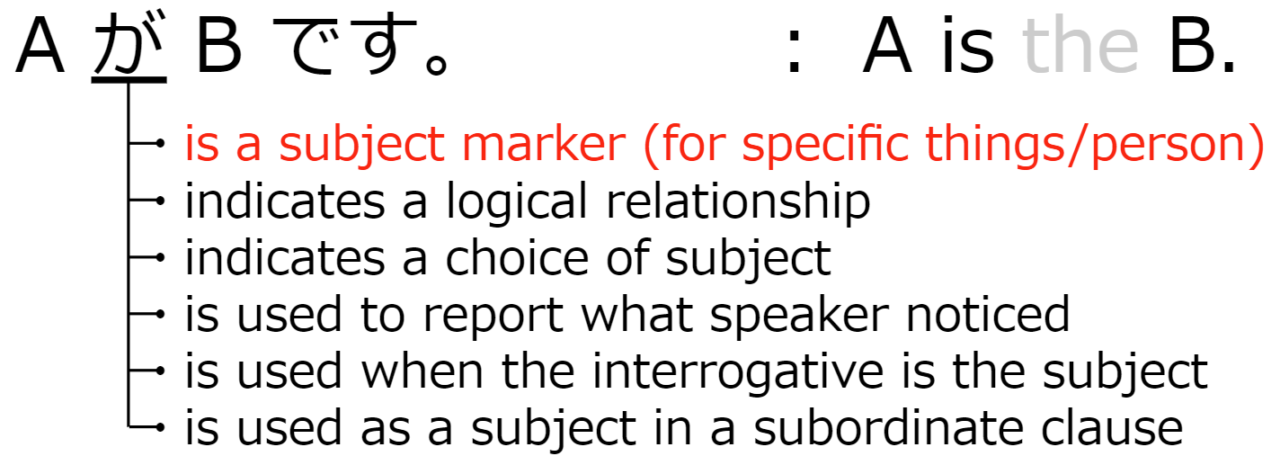
The particle が is often translated as a subject marker, but its actual usage is more nuanced than that.
While は introduces or revisits a topic, が often focuses attention on the subject itself or introduces new information.
A simplified explanation is:
は = topic / shared context
が = subject / focus / new information
However, the real difference depends heavily on context, emphasis, and the speaker’s intention.
・functions as a subject marker
・indicates a logical relationship
・indicates a choice of subject
The particle が is commonly used when the speaker wants to identify or emphasize a specific subject.
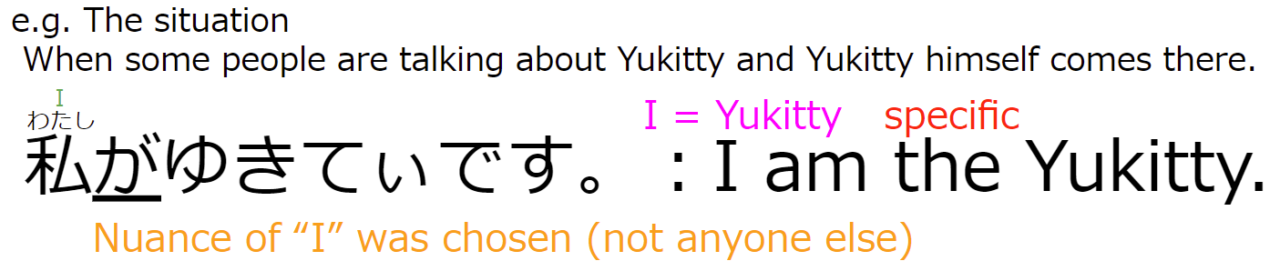
Compared with は, the particle が often sounds more direct and focused.
Many English textbooks oversimplify the difference between は and が. In reality, native speakers choose them based heavily on nuance and context.
・used when reporting something the speaker noticed
Japanese frequently uses が when the speaker discovers, notices, or experiences something directly.
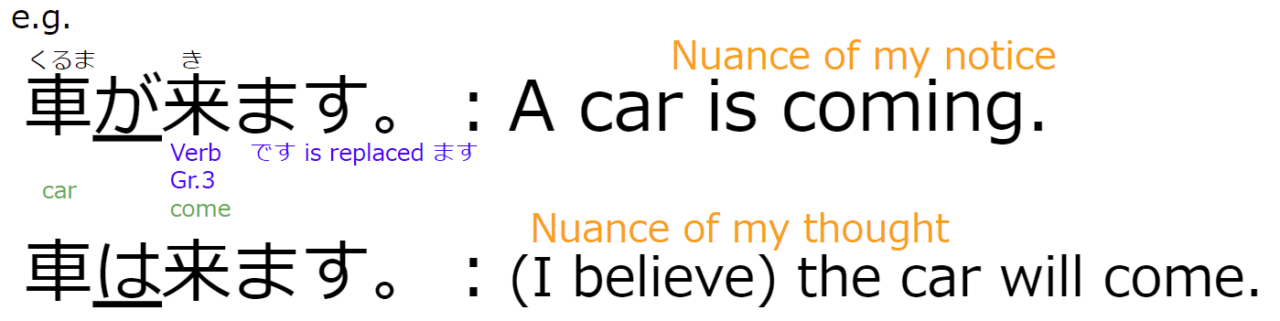
This usage often feels emotional or immediate compared with は. Think of a character in an anime suddenly shouting “鬼がいる!” (There’s a demon!) — が marks the brand-new thing they just spotted.
・used when an interrogative word is the subject
Question words such as 誰 (who), 何 (what), and どこ (where) are commonly followed by が when they function as the subject of the sentence.
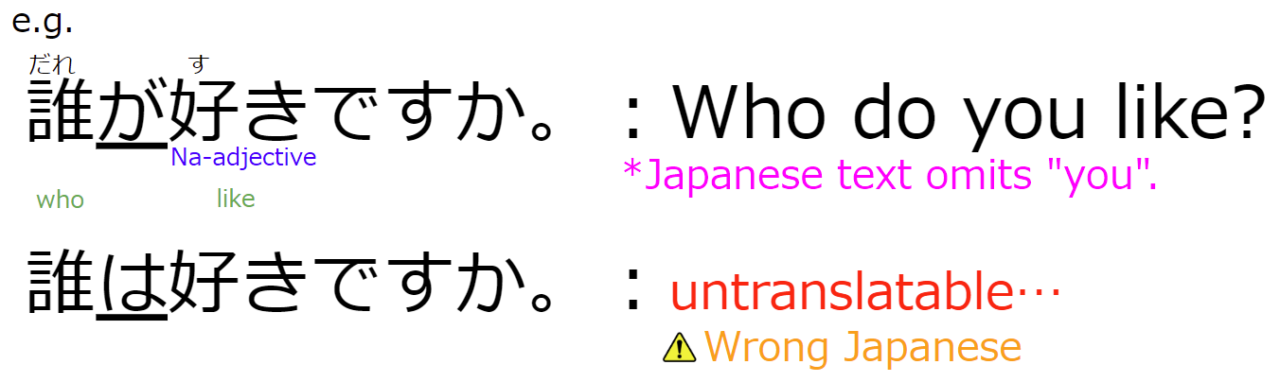
This is one of the most consistent grammatical uses of が.
・used as the subject inside subordinate clauses
The particle が is frequently used inside embedded clauses and subordinate sentences.
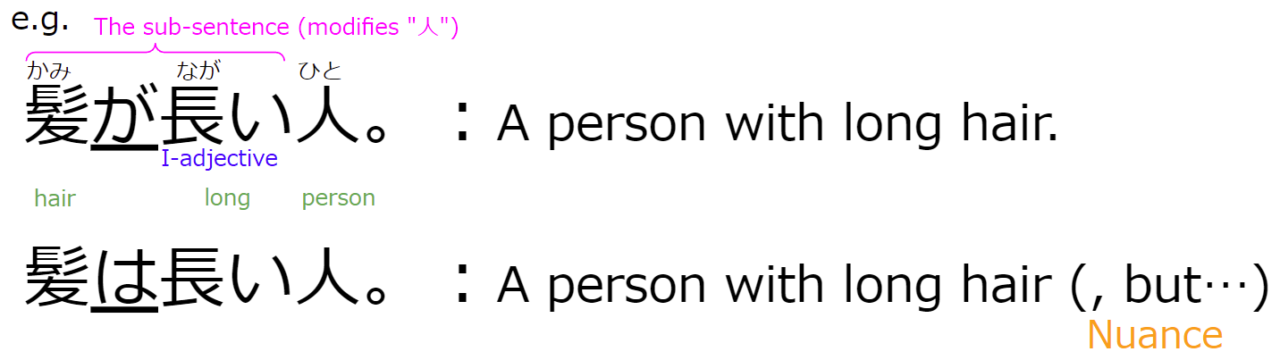
This is another reason why translating Japanese particles directly into English is often difficult.
One of the biggest differences between Japanese and English is the amount of information that can be omitted.
English usually requires explicit subjects:
In Japanese, subjects are frequently omitted when they are already understood from the context.
Japanese communication relies heavily on shared context and implicit understanding.
Because of this, directly translating English sentence structure into Japanese often sounds unnatural.
This is exactly why anime dialogue can feel so short and punchy — half the sentence is “understood” and left unsaid. Once your ear adjusts, you’ll start filling in the blanks automatically! 🍙
The sentence pattern A は B です。 may look simple, but it contains many important ideas that are central to Japanese grammar.
Understanding these concepts will help you sound much more natural in Japanese.
Mastering the difference between は and が is one of the most important steps toward understanding natural Japanese.
Continue studying these particles gradually through real examples and conversation practice. Try spotting は and が in your favorite anime or manga — once you start noticing them, they’re everywhere!









Comment