


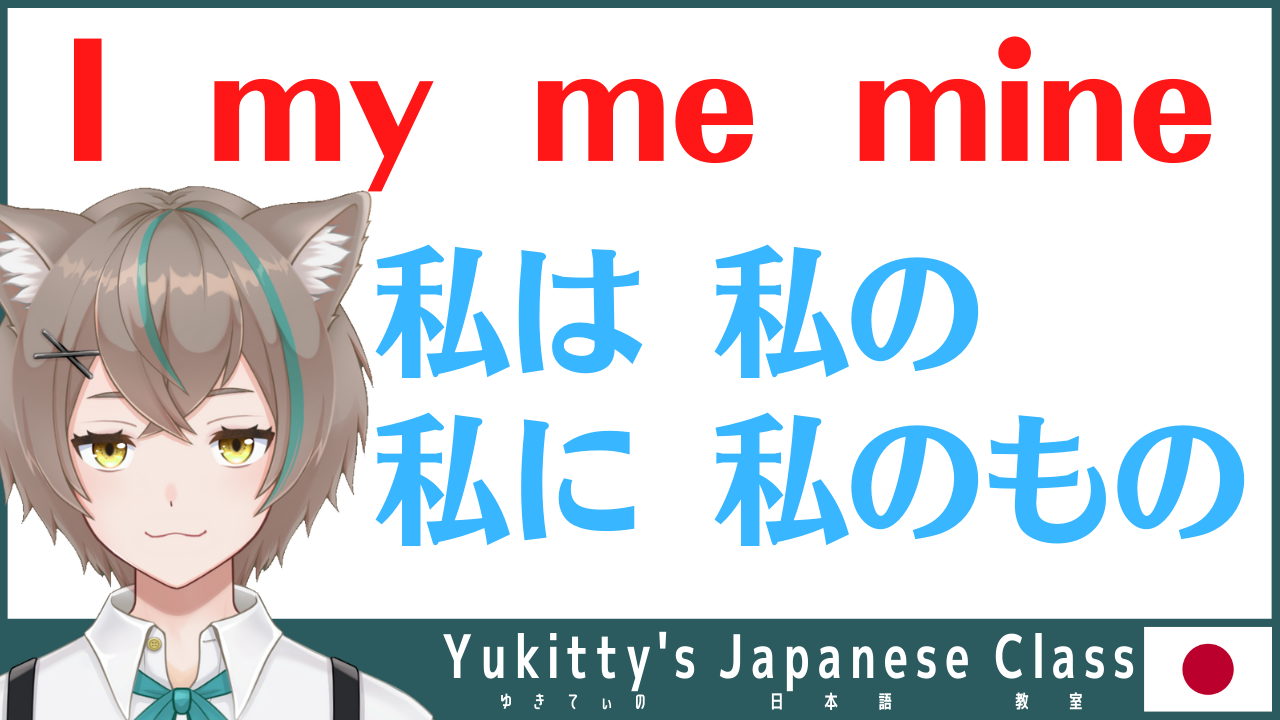
In Japanese, words like “I,” “my,” “me,” and “mine” are usually expressed by combining a pronoun with a particle.
Unlike English, Japanese does not change the pronoun itself very much. Instead, the particle after the pronoun shows its role in the sentence.
The basic idea is simple: pronoun + particle.
| Pronoun | Topic / Subject (I) | Possessive (my) | Object / Target (me) | Possessive Pronoun (mine) | |
|---|---|---|---|---|---|
| rule | – | +は | +の | +に +を | +のもの |
| I | 私 | 私は | 私の | 私に 私を | 私のもの |
| you | あなた | あなたは | あなたの | あなたに あなたを | あなたのもの |
| he | 彼 | 彼は | 彼の | 彼に 彼を | 彼のもの |
| she | 彼女 | 彼女は | 彼女の | 彼女に 彼女を | 彼女のもの |
| it | それ | それは | その | それに それを | その |
| we | 私たち | 私たちは | 私たちの | 私たちに 私たちを | 私たちのもの |
| you (plural) | あなたたち | あなたたちは | あなたたちの | あなたたちに あなたたちを | あなたたちのもの |
| they ♂ | 彼ら | 彼らは | 彼らの | 彼らに 彼らを | 彼らのもの |
| they ♀ | 彼女ら | 彼女らは | 彼女らの | 彼女らに 彼女らを | 彼女らのもの |
| they (things) | それら | それらは | それらの | それらに それらを | それらの |
The words highlighted in yellow do not follow the basic pattern exactly, so pay special attention to them.
For example, “my” is usually expressed with の, as in 私の. However, “its” is usually その, not それの, in natural Japanese.

Japanese people do not use pronouns as often as English speakers do. If the subject or object is clear from the context, it is usually omitted. If it is not clear, Japanese speakers often use the person’s name instead. Words like “you,” “he,” and “she” can sound slightly emphasized or unnatural if they are used too often.
Japanese has many ways to say “I” and “you.” These words can express gender, age, personality, politeness, region, or even a fictional character style.
Be careful: many of these words are not suitable for everyday conversation. Some sound rude, old-fashioned, regional, or fictional.
The following words can all mean “I” in Japanese. The ratings below are based on my personal impression as a native Japanese speaker.
| Variation | ♂ | ♀ | Kids | Youth | Adult | Older | Formal | Impression / Peculiarity |
|---|---|---|---|---|---|---|---|---|
| 私 | **** | ***** | ** | *** | ***** | ***** | **** | standard, polite |
| 私 | *** | *** | * | * | *** | *** | ***** | very formal |
| 俺 | ***** | * | ** | ***** | **** | *** | ** | casual, masculine |
| 僕 | ***** | * | **** | ***** | *** | ** | *** | soft masculine, semi-formal |
| あたし | * | ***** | *** | **** | *** | ** | *** | casual, feminine |
| あたい | * | ** | ** | ** | ** | * | * | casual, rough, old-fashioned |
| うち | ** | ***** | *** | **** | *** | ** | ** | casual, often feminine or regional |
| 自分 | *** | ** | * | *** | *** | * | *** | casual, sometimes used in sports or military-like speech |
| 吾輩 | ** | * | * | ** | ** | ** | *** | retro, literary |
| わし | ** | ** | * | * | ** | *** | ** | older-person style, fictional |
| わい | ** | * | * | ** | ** | * | ** | Kansai / Osaka-like style |
| わて | ** | ** | * | ** | ** | * | ** | Kansai / Osaka-like style |
| わ | ** | * | * | * | ** | ** | ** | Okinawan style |
| わらわ | * | ** | * | * | ** | ** | ** | retro, princess-like speech |
| わっち | * | ** | * | ** | ** | * | * | retro, fictional |
| あっし | ** | ** | * | ** | ** | * | * | retro, rough style |
| おら | ** | * | ** | ** | * | * | * | rural / countryside style |
| おいら | ** | * | ** | ** | * | * | * | rural / casual style |
| おれっち | ** | * | ** | ** | ** | * | * | Shizuoka-like style |
| 拙者 | ** | * | * | * | ** | ** | **** | samurai-like, retro |
| 小生 | ** | * | * | * | ** | ** | ***** | formal, old-fashioned, male writing style |
| まろ | * | * | * | * | * | * | ** | ancient / noble-like style |
| ミー | ** | * | * | ** | ** | * | ** | foreign-character style |
For beginners, 私 is the safest choice in most situations. Men may also hear or use 僕 or 俺, but these depend strongly on tone and relationship.
The following words can mean “you” in Japanese. The ratings below are also based on my personal impression as a native Japanese speaker.
| Variation | ♂ | ♀ | Kids | Youth | Adult | Older | Formal | Impression / Peculiarity |
|---|---|---|---|---|---|---|---|---|
| あなた | **** | **** | * | *** | ***** | **** | **** | standard, but often avoided in conversation |
| あんた | ** | *** | ** | *** | *** | *** | * | familiar, can sound rude |
| 君 | **** | *** | ** | *** | *** | *** | ** | familiar, sometimes used downward |
| お前 | ** | ** | * | *** | *** | *** | * | familiar, rough, can be rude |
| てめえ | *** | * | * | ** | ** | * | * | hostile, very rude |
| そちら | *** | *** | * | * | ** | ** | *** | polite-ish, indirect |
| おたく | ** | *** | * | * | ** | ** | ** | casual, also means “geek/nerd” in modern Japanese |
| 自分 | ** | ** | * | ** | ** | * | ** | casual, regional or group-dependent |
| 貴様 | * | * | * | ** | ** | ** | * | hostile, rude in modern Japanese |
| 貴殿 | * | * | * | * | ** | ** | ***** | formal, old-fashioned writing style |
| お主 | * | * | * | * | ** | ** | ** | retro, fictional |
| なんじ | * | * | * | * | ** | ** | * | archaic, biblical or fantasy-like |
| ユー | * | * | * | ** | ** | * | ** | foreign-character style |
For beginners, it is usually better to avoid using “you” directly in Japanese. Use the person’s name instead when possible.
お前の妹は美人だよ
鬼滅の刃 ©吾峠呼世晴/集英社・アニプレックス・ufotable
お前 is very casual and can sound rude depending on the relationship. Do not use it with strangers, teachers, customers, or people above you.
僕は君に会うために生まれてきたのかもしれない
新世紀エヴァンゲリオン ©カラー/Project Eva.
僕 and 君 can sound soft or poetic in some contexts, but they still depend heavily on the speaker, listener, and situation.
Translate the following sentences into Japanese.
My pen and her pen were given by him.
_____ペンと_____ペンは_____もらいました。
We asked him to call your mother.
_____ _____ _____のお母さんを呼ぶように頼んだ。
Japanese pronouns work differently from English pronouns. Instead of changing the form like “I,” “my,” “me,” and “mine,” Japanese usually adds particles such as は, の, に, and を after the pronoun.
The most important thing is not to overuse pronouns. Natural Japanese often omits pronouns when the meaning is clear from context.
For beginners, 私 is the safest word for “I,” and using someone’s name is often safer than saying “you” directly.




Comment